Identity & emotional recognition
Sun Conjunct Moon Synastry: Recognition Meets Emotional Need
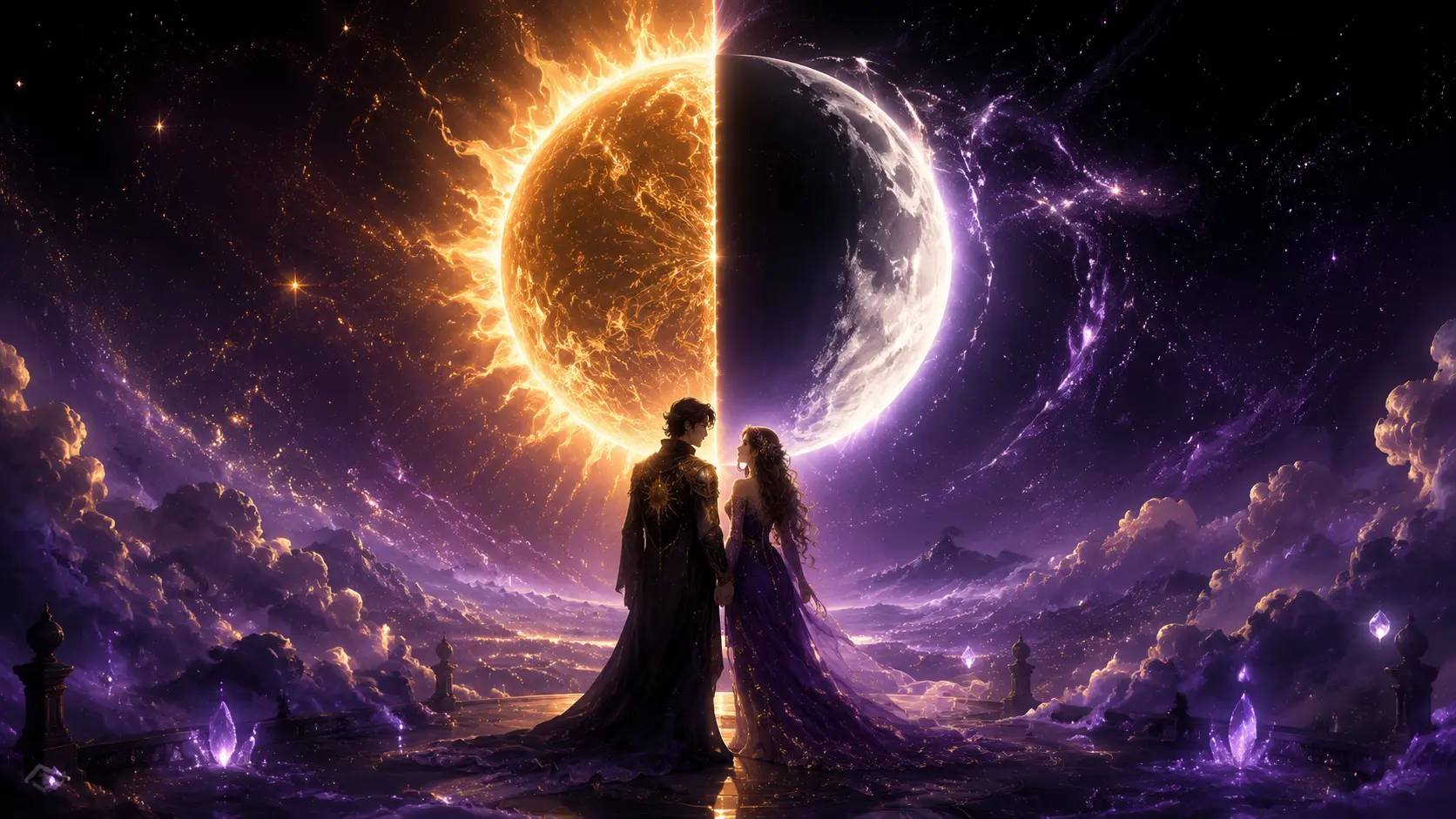
Sun conjunct Moon is often experienced as a strong sense of recognition. The Sun person may feel seen or affirmed by the Moon person’s emotional attention, while the Moon person may feel that the Sun person gives shape or light to something deeply familiar. The contact can create a feeling of “we get each other,” but its value is not in a promise of permanence. Its value is in the way it can make each person’s inner and outer lives more visible to the other.
Calculation receipt
- Target angle
- 0° conjunction
- Guide orb
- ≤ 7.0° in the Velvet Zodiac major-aspect engine
- Direction
- Sun → Moon and the reverse direction is checked separately
- Birth-time boundary
- An unknown-time Moon is tested across its daily longitude window and labeled Stable / Conditional / Omit.
01
The comfort of being recognized
The Sun often speaks to identity, direction, and the wish to be acknowledged. Moon speaks to emotional instinct and the need for a feeling of home. When they meet, a person can feel that their ordinary self is not too much to bring into the relationship. There may be warmth around shared plans, celebrations, or simply being together in familiar spaces.
This aspect can be especially meaningful when people have struggled to feel understood elsewhere. That history can make the recognition feel precious—and can also make it tempting to put too much pressure on one person to always provide it. Appreciation works best when it is shared rather than made into a job.
02
Keeping recognition from becoming expectation
Over time, the Sun person may want room to change, while the Moon person may want reassurance that change does not threaten closeness. Both needs are legitimate. The practical task is to make adjustment visible: say what is evolving, say what remains dependable, and give the other person a chance to respond.
The aspect becomes most supportive when care is specific. Instead of assuming you know how the other person feels, ask. Instead of assuming they will always recognize your intentions, explain. Familiarity is a foundation, not a substitute for attention.
Check your charts
Do you have this aspect?
Enter two birth records to check the focused orb used in this guide. A missing result does not settle the relationship; it only means this exact contact was not detected here.
Full-chart synastry
See the conversation
between two charts.
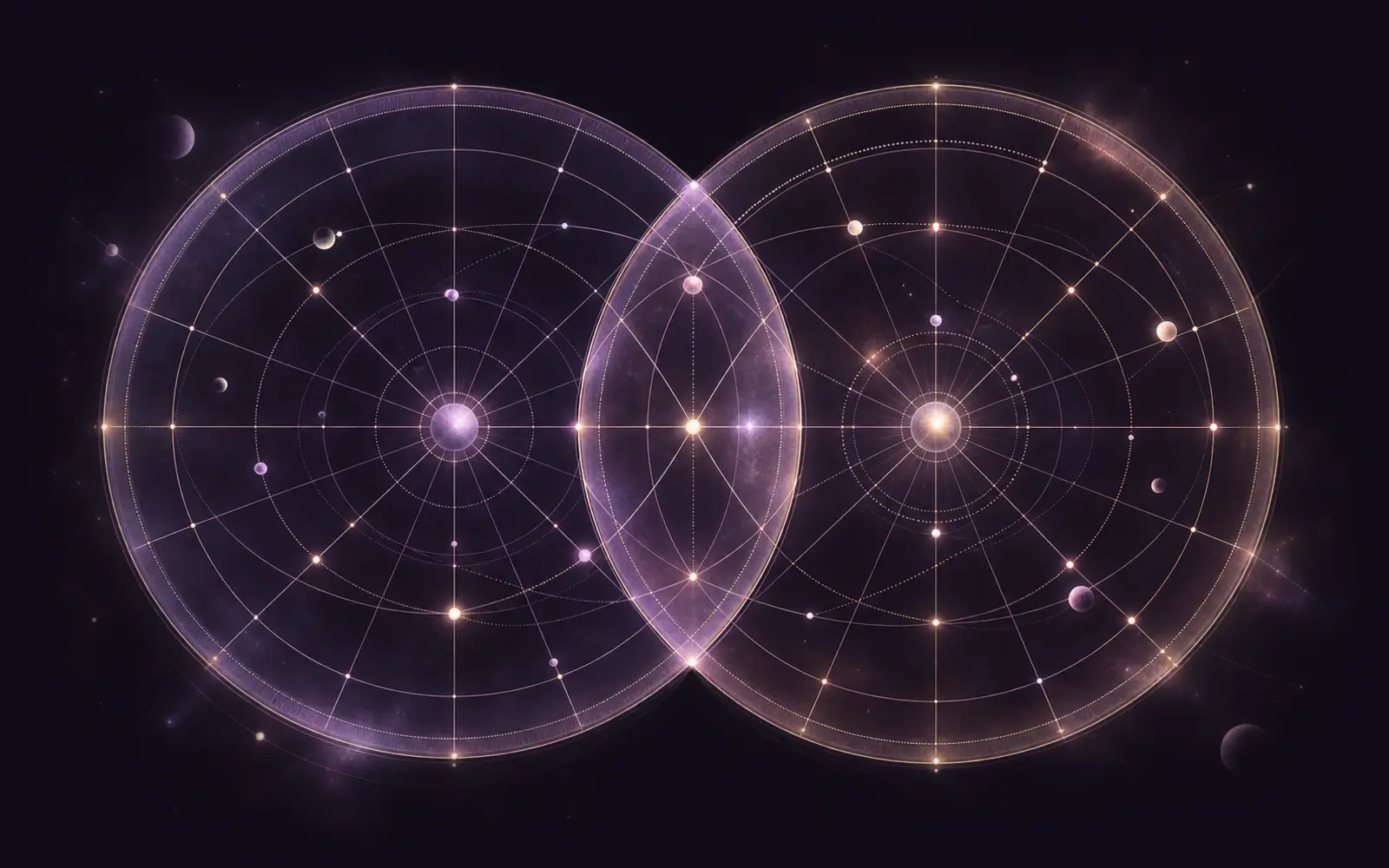
Enter two birth records to check for Sun conjunction Moon; unknown birth times are allowed. This is a map for conversation—not a compatibility score.
03
A question to bring into real life
Ask: “What part of you feels most recognized with me, and what part still needs more language?” The answer can show you where the contact is nourishing and where a simple new practice of care could help.
04
Why this contact receives a wider orb
Sun and Moon are the two luminaries, and Velvet Zodiac allows them the full conjunction orb used by the major-aspect engine. That does not mean every contact inside the limit is equally important. A conjunction within a degree is geometrically tighter than one near the edge of the allowed orb, so it is reasonable to give the tighter contact more weight when several aspects compete for attention.
The aspect is also directional in experience even though the geometry is shared. The Sun person may feel recognized when the Moon responds to their way of being, while the Moon person may feel that their emotional reactions are unusually visible to the Sun. Those are interpretive possibilities, not fixed roles. Either person can be the more expressive, private, steady, or changeable one in real life.
05
Birth-time confidence matters because the Moon moves quickly
This is one of the contacts where an unknown birth time can materially change the result. Velvet Zodiac does not take a single noon Moon and print it as exact. When a Moon birth time is unknown, the calculator tests the Moon’s daily longitude window against the other chart and labels the contact Stable, Conditional, or Omit. Stable means the aspect survives across the tested Moon window; Conditional means it exists only for part of that window.
That confidence label applies to the Moon contact, not to the entire chart. Rising signs, MC, and exact house overlays still require usable birth times. If a page or third-party calculator gives a precise house story from an unknown-time chart, treat that precision skeptically.
06
What the natal Sun and Moon bring into synastry
The conjunction often gets praised as automatic emotional understanding, but natal context can make it much more complicated. A Moon with strong Saturn contacts may need time before showing vulnerability. A Sun closely tied to Uranus may protect independence even when recognition feels good. The synastry conjunction links those patterns; it does not erase them.
It also helps to compare communication and conflict contacts. Feeling emotionally recognizable is not the same as knowing how to repair after disagreement. Mercury contacts can describe translation and listening; Mars contacts can describe the pace of action and friction; Saturn can show where responsibility or inhibition becomes important.
07
How composite repetition changes emphasis
Synastry Sun conjunct Moon describes a cross-chart relationship between two natal points. A composite Sun–Moon aspect is a different calculation, representing the midpoint relationship chart. If both lenses emphasize Sun–Moon, the theme of identity meeting emotional rhythm is repeated and may deserve more attention in the Relationship Report.
Repetition should still not be turned into a soulmate score. A relationship can contain elegant Sun–Moon geometry and still fail on availability, honesty, values, or safety. Use the repeated theme to generate better questions: Do both people feel known? Is emotional support reciprocal? Can one person grow without the other treating change as rejection?
Common questions
Is Sun conjunct Moon a marriage aspect?
It may feel bonding, but no single aspect predicts marriage or long-term health. Real compatibility includes communication, values, and the choices people make together.
Who is the Sun person and who is the Moon person?
In synastry, the person whose Sun is contacted is called the Sun person, and the person whose Moon is contacted is called the Moon person. Both influence the dynamic.