Synastry 101
How to Read a Synastry Chart: A Complete Beginner’s Guide
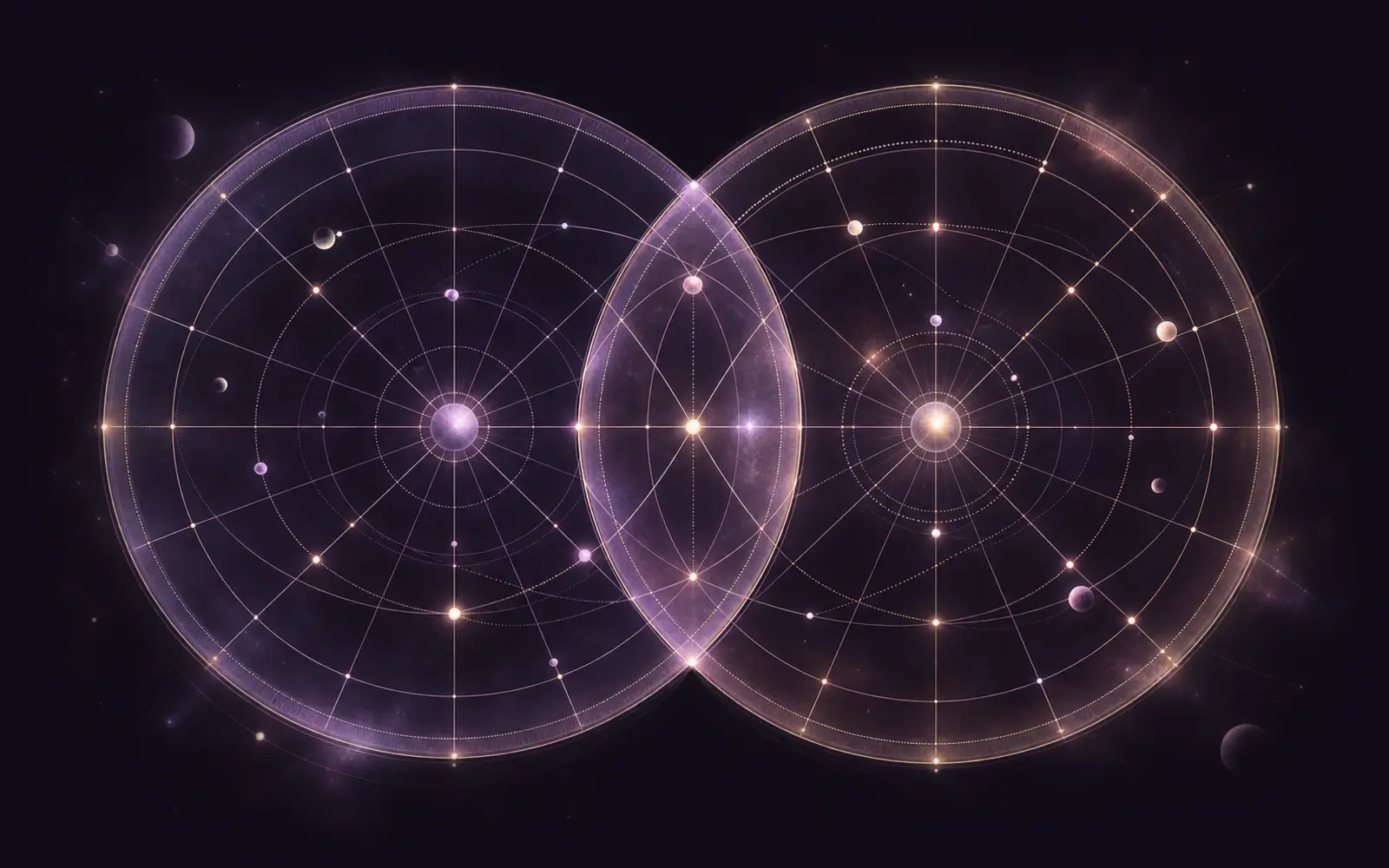
A synastry chart compares two birth charts. It is not a relationship report card. The most useful way to approach it is as a map of themes: where two people may feel immediate recognition, where they may communicate differently, and where conscious effort could make a difference.
01
Get the basic data right first
A full synastry chart uses each person’s birth date, time, and place. Exact birth time is especially important for the Rising sign, houses, and sometimes the Moon. If either time is uncertain, do not force an exact house reading. Work with the placements you can verify and make the uncertainty visible rather than pretending the chart is more precise than it is.
For a first reading, begin with the familiar placements: Sun, Moon, Mercury, Venus, and Mars. You do not need to inspect every symbol at once. A chart becomes much easier to understand when you choose one relationship question at a time.
02
Read planet pairs before you read everything
Sun–Moon contacts are often used to explore the meeting point between identity and emotion. Moon–Moon contacts can be a useful lens for comfort and daily sensitivity. Mercury contacts can describe whether two people naturally understand each other’s reasoning or need to slow down and clarify. Venus and Mars contacts are frequently discussed around attraction, affection, and initiative.
Saturn is worth approaching with nuance. It is often associated with responsibility, commitment, and structure, but can also show where a connection feels heavy or where one person becomes overly cautious. The point is not to label a planet as good or bad. It is to ask how that theme is being lived.
Keep exploring: Which Synastry Aspects Should You Look At First? · Why a Compatible Birth Chart Can Still Feel Difficult in Real Life
03
What aspects are—and are not
An aspect is the geometric relationship between two placements. Conjunctions often concentrate a theme. Trines and sextiles are commonly read as flowing or cooperative. Squares and oppositions can describe friction, contrast, or activation. But “easy” is not always deep, and “challenging” is not always destructive. A square may reflect a recurring lesson the couple learns to handle with honesty; a trine may become passive if no one brings intention.
Look for repetition. One Venus–Mars contact is a detail. A chart with repeated links to the Moon, Mercury, and Saturn tells a broader story about emotional contact, communication, and endurance. Patterns are more meaningful than collecting a list of supposedly perfect aspects.
04
End with reality, not the chart
After you look at placements, step away from the wheel and ask what is actually happening. Do you feel safe speaking honestly? Can both people repair a rupture? Are boundaries respected? Does the relationship make room for both people’s lives? These questions should guide your choices even when a chart feels magnetic or dramatic.
Synastry is best used for reflection. It can make a pattern easier to name, but it cannot promise compatibility, explain away harm, or tell you what you must tolerate. Let the chart create better questions; let real behavior provide the answers.
05
A calm order for a first reading
A beginner can get more value from a short, organized reading than from twenty tabs of aspects. Start with the Sun, Moon, Mercury, Venus, and Mars. Note the contacts that repeat a theme. Then write a plain-language summary: where there seems to be warmth, where timing may be different, and which conversation could make the connection clearer.
Stop before the chart becomes a surveillance tool. Synastry should not be used to track an ex, decode every delayed text, or manufacture certainty where there is not enough information. When a relationship question has a direct answer available through conversation, choose the conversation.
06
Keep the reading proportional
A synastry chart can feel intensely personal, especially when a description seems to fit. Give it proportion. One aspect does not explain a whole relationship, and a whole chart does not erase the evidence of day-to-day behavior. Strong feelings about an interpretation are a reason to slow down, not a reason to decide faster.
When you share a reading with someone else, present it as curiosity rather than diagnosis. “This made me think about how we handle distance” is an invitation. “Your chart says you always do this” is a shortcut to defensiveness.
07
Turn a chart pattern into a usable question
After noticing a contact or a repeated theme, pause before turning it into an explanation. Write a question in everyday language instead. A Moon–Mercury theme might become: When we are upset, do we need to talk at the same pace? A Venus–Mars theme might become: How do we signal desire, initiative, or a need to slow down? A Saturn theme might become: Does responsibility feel shared, supportive, or heavy? The question is more valuable than a one-line interpretation because it can be answered by the people who are actually living the relationship.
Keep a boundary around the question. You are looking for clarity, not evidence to win an argument or persuade someone to stay. If a pattern shows up, ask whether both people want to work with it and whether the work is already visible in their behavior. The most responsible reading leaves room for a person to say that a description does not fit, a concern is larger than the chart, or a direct conversation is needed before any more interpretation.
08
Know when to close the chart
More chart detail is not always more insight. Close the chart when you notice that you are trying to decode a delayed text, explain a boundary someone has already stated, track an ex, or turn uncertainty into a prediction. These are moments when additional aspects can become a form of surveillance or reassurance-seeking rather than reflection. A full synastry chart cannot give you permission to ignore someone’s words, and it cannot manufacture a stable relationship from inconsistent contact.
Instead, return to a direct measure: do you feel informed, respected, and able to speak freely? Is a need being met, negotiated, or repeatedly avoided? If the answer is difficult, let it remain difficult long enough to make a wise choice. Synastry is most generous when it helps people communicate with more care; it is least useful when it becomes a reason to postpone a decision that real behavior has already made clear.
09
A respectful way to read with a partner
If you read synastry together, agree that neither person will use a placement as an accusation. Start by asking which relationship question each of you is willing to explore. Share observations in first-person language: I noticed I need more warning before plans change; I feel close when we repair quickly; I get defensive when I think I am being analyzed. This keeps the chart from becoming a third voice that either person can use to win the conversation.
Take turns choosing a theme, and stop when the reading stops producing useful language. You do not need agreement on every symbol to have a respectful exchange. What matters is whether the conversation makes each person more understood and more free to state a boundary or preference. That is a healthier success measure than whether both charts seem to contain enough easy aspects. If the conversation becomes defensive, return to the actual concern and leave the chart aside. The goal is a clearer relationship, not a more impressive reading.
Common questions
Do I need both birth times for synastry?
Exact times make the chart much more complete because houses and Rising signs depend on them. If a time is unknown, use only the placements that can be calculated with confidence.
Are squares and oppositions always bad in synastry?
No. They are commonly interpreted as tension or polarity, which can become growth, attraction, irritation, or all three depending on how people handle the dynamic.
Can a synastry chart predict whether a relationship will last?
No. A chart can offer symbolic themes, but it cannot measure safety, shared values, life circumstance, consent, or the choices two people make over time.
Velvet Zodiac takeaway