Compatibility basics
Sun Sign vs. Moon Sign Compatibility: Which Matters More?
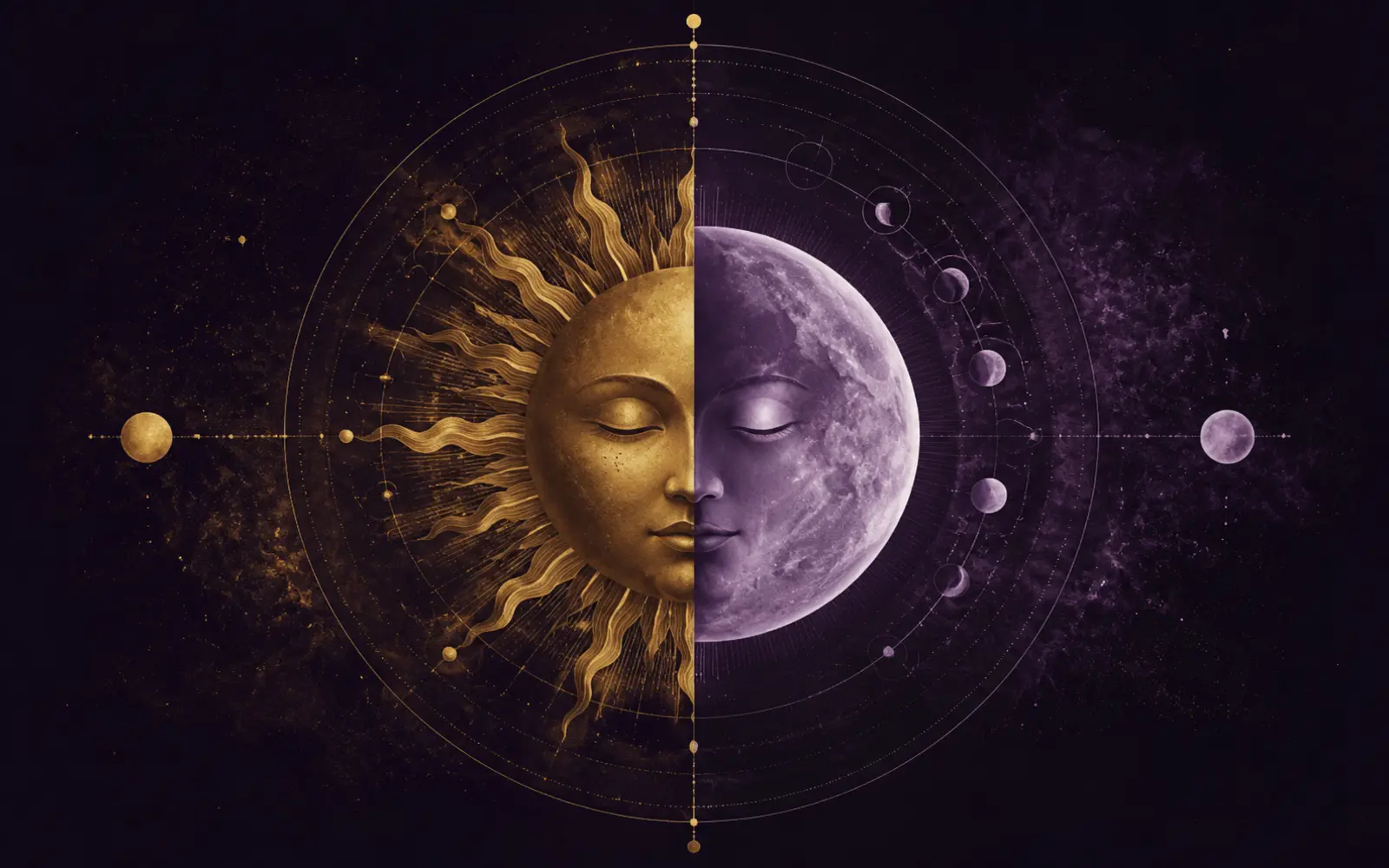
The honest answer is that neither Sun-sign compatibility nor Moon-sign compatibility “wins.” They are different lenses. A useful reading asks which layer of the relationship you are trying to understand before you decide what to compare.
01
Start with the question, not the ranking
When people ask whether Sun or Moon compatibility matters more, they are usually asking about something specific. Are we drawn to each other? Do we understand one another? Why do we keep missing each other after arguments? The Sun is commonly used to discuss identity, confidence, and the direction a person wants to grow toward. The Moon is commonly used to discuss emotional habits, reassurance, and instinct.
That means a Sun comparison can be a helpful way to talk about pace, shared interests, and the energy two people bring into a room. A Moon comparison may be more revealing when the concern is comfort, vulnerability, or what happens after the room gets quiet.
02
A familiar Sun connection can still need emotional translation
Two people may have Sun signs that make socializing, planning, or pursuing goals feel easy. They may enjoy the same tempo and still have completely different stress responses. When the relationship is light, that gap may barely show. When there is disappointment or uncertainty, the Moon layer may suddenly become more noticeable.
The opposite can also be true. A couple may have an easy feeling of emotional recognition while still needing to negotiate identity, independence, or life direction. The chart is not there to decide which kind of ease matters most. It helps you see what each kind of ease is—and what it does not automatically solve.
Keep exploring: Moon Sign Compatibility: A Practical Guide to Emotional Fit · Moon Sign Compatibility by Element: What Emotional Fit Can Actually Tell You
03
A simple way to read both together
First, compare the two Sun signs and ask: how do these people encourage each other’s confidence, choice-making, and visible life? Next, compare the two Moon signs and ask: how do they seek comfort, process feelings, and repair after strain? Finally, look at Sun-to-Moon contacts in a full synastry chart. Those contacts are often used to explore the meeting point between one person’s identity and another person’s emotional world.
Keep the language practical. Instead of interpreting a trine as an automatic green light or a square as a warning, look for the real-life version. Ease might mean conversations begin naturally. Tension might mean the couple has to learn timing and patience. Neither is a substitute for consent, kindness, or compatible goals.

04
The placements that round out the picture
Venus adds information about affection and values. Mercury gives another lens for how people think, explain, and misunderstand. Mars can describe how desire, initiative, and irritation show up. Rising signs and houses can add context to the tone and area of life where the connection feels especially immediate.
That is why a simple “best signs for you” list should be treated as an opening, not a conclusion. If a match seems unlikely on paper but feels respectful and nourishing in real life, that real-life evidence deserves more weight than a generic chart rule.
05
Do not use either sign as an excuse
It is tempting to explain a hard moment with a phrase such as “That is just my Moon” or “We are incompatible because of our Suns.” That can be a playful shorthand, but it is not an accountability practice. Every person still chooses how they speak, listen, apologize, and honor a boundary.
A more useful approach is to let the sign language point toward a skill. If someone needs time, practice stating that time. If someone needs reassurance, practice asking for it without accusation. The chart becomes valuable when it encourages a more responsible version of the relationship you already have.
06
Turn the insight into a real conversation
A useful Sun-and-Moon check-in can be very short: “What makes you feel supported in the life you are building?” followed by “What helps you feel safe when things are hard?” The first question makes room for Sun-sign themes of identity and direction; the second makes room for Moon-sign themes of comfort and response.
You do not need astrology vocabulary to answer either question. That is the test of whether an interpretation has value. If it helps two people speak more honestly in ordinary language, keep it. If it only produces labels, it is not doing enough.
07
Use the Sun conversation when the issue is direction
A Sun-sign comparison can be most helpful when the tension is not primarily emotional but directional. Maybe one person feels energized by a big change while the other needs a slower, more deliberate path. Maybe one person wants public recognition, adventure, family-building, creative focus, or more independence, and the other has a different sense of what a good life looks like. These differences do not have to become a referendum on the relationship. They do need room to be named before they turn into a pattern of one person shrinking their life to preserve harmony.
Try a future-facing check-in: What are you trying to grow in this season? What support feels encouraging instead of controlling? Where do you need the relationship to make room for you? The answers will tell you more than a compatibility list. Sun-sign language can give the conversation an opening, but the real work is discovering whether two people can celebrate each other’s direction without needing their ambitions to match exactly.
08
Use the Moon conversation when the issue is repair
When a conflict lingers after the practical issue has been solved, the Moon layer may be the more useful lens. Ask what each person needed in the moment: time, reassurance, acknowledgement, a plan, privacy, touch, a chance to explain, or a signal that the relationship was still safe. The goal is not to make a partner responsible for regulating every feeling. It is to learn which responses lower defensiveness and which ones reliably make the rupture larger.
A repair plan works best when it is observable. One person might agree not to disappear without a return time; another might agree to state that they need comfort before they debate facts. You can then revisit the plan after a real disagreement and see whether it made reconnection easier. This is the useful distinction between Sun and Moon compatibility: one helps frame the life you are building, the other helps frame how you come back to each other while building it.
09
Choose the question before choosing the placement
If you keep asking whether Sun or Moon signs matter more, pause and name the question underneath. Are you trying to understand attraction, the pace of daily life, conflict recovery, affection, communication, or a future decision? Each question points toward a different part of a chart and a different real-life conversation. This prevents a useful tool from becoming a ranking contest where one placement has to explain everything.
A simple rule helps: use the Sun for the way two people move toward life, use the Moon for the way they return to emotional safety, then look elsewhere when the question is about affection or communication. The chart gains depth when each placement has a clear job. Your relationship gains clarity when no placement is allowed to become a verdict. You can revisit the question later as circumstances change instead of looking for one final answer. That practice turns a symbolic distinction into a conversation you can use next week.
Common questions
Are Sun signs or Moon signs more accurate?
They are not competing measurements. In astrology they are used to describe different symbolic layers, so the more useful question is which relationship experience you want to explore.
Why can a Sun-sign match feel easy but still become difficult?
Shared interests or pace do not automatically create the same emotional repair style, values, communication habits, or life goals.
What should I compare after Sun and Moon signs?
Venus, Mercury, Mars, Rising signs, and aspects between the two full charts can add nuance—provided the birth information is reliable.
Velvet Zodiac takeaway